Demands · Chronology
How CJP protest demands changed — Pradhan resigns; FIR path & August agenda
Not affiliated with CJP, any party, or government. Each phase cites public sources. Last reviewed 9 August 2026.
Abhijeet Dipke / CJP
Phase 01
Launch political manifesto
On the day CJP launched online, Dipke published a satirical five-point political manifesto. This is the platform set before the movement pivoted fully to education-street demands.
- 01
No Chief Justice shall be granted a Rajya Sabha seat as a post-retirement reward
- 02
If any legitimate vote is deleted, the Chief Election Commissioner shall be arrested under UAPA
Framed as treating denial of voting rights as “no less than terrorism,” in reference to electoral-roll controversies.
- 03
50% women’s reservation in Parliament (without expanding seats) and 50% of Cabinet positions for women
- 04
Cancel licences of Adani- and Ambani-owned media houses; investigate “Godi media” anchors’ bank accounts
Stated as clearing space for independent media.
- 05
Any MLA or MP who defects shall be barred from contesting and holding public office for 20 years
Sources
On the timeline
- 01
Abhijeet Dipke / CJP
Phase 02
First street protest + Pradhan ultimatum
CJP’s first physical protest at Jantar Mantar centred on Union Education Minister Dharmendra Pradhan’s resignation after the NEET 2026 paper leak and CBSE On-Screen Marking controversies. Organisers cited a large online petition seeking his removal.
What changed: The movement shifted from the May political manifesto to an education-accountability street agenda.
- 01
Resignation / sacking of Dharmendra Pradhan
Framed as moral and administrative responsibility for NEET 2026 irregularities, CBSE OSM issues, and broader exam failures.
- 02
Same-day 5 pm resignation deadline, then a seven-day ultimatum
Dipke set a 5 pm deadline at the protest; spokesperson Ashutosh Ranka later warned of nationwide agitation if Pradhan was not removed within seven days.
- 03
Reset / accountability in the education system
Ranka described removing the minister as a precondition for meaningful reform.
Sources
On the timeline
- 01
Abhijeet Dipke / CJP · Pune
Phase 03
Exam manifesto (five-point reform charter)
At Savitribai Phule Pune University, CJP launched a nationwide education agitation and released a five-point “exam manifesto.” Press lists vary slightly; points below follow The Times of India five-point list with The Hindu’s additional “results within a month” note.
What changed: Alongside Pradhan’s resignation, CJP published concrete examination-system reforms.
- 01
₹10,000 compensation for students affected by paper leaks, postponed exams, or delayed results
Described as covering preparation and travel hardship when exams collapse.
- 02
Mandatory backup / re-examination within 72 hours of cancellation
The Hindu also reported a demand for advance announcement of backup dates when exams are cancelled.
- 03
Physical evaluation of answer sheets instead of digital-scan-only assessment
Aimed at OSM / on-screen marking controversies.
- 04
Automatic age-limit / attempt protection when delays hurt eligibility
- 05
Independent technology and tender audits for exam systems and CBT vendors
Including merit-based allocation of examination contracts, per multiple reports.
- 06
Declaration of results within one month of an examination
Reported by The Hindu and some other outlets alongside the five-point set.
Sources
On the timeline
- 01
Abhijeet Dipke · open letter to PM Modi
Phase 04
₹1 crore compensation demand enters the charter
Ahead of the 20 June Delhi sit-in, Dipke wrote an open letter to Prime Minister Narendra Modi seeking compensation for families of NEET aspirants who died by suicide amid the paper-leak crisis. Early coverage cited about 11 deaths; later CJP records cited 21.
What changed: ₹1 crore per deceased aspirant’s family became a standing CJP demand alongside Pradhan’s resignation.
- 01
₹1 crore compensation to families of NEET aspirants who died by suicide amid the paper-leak crisis
- 02
Accountability / resignation of Dharmendra Pradhan
Paired with the compensation ask in open-letter coverage.
- 03
Students to assemble at Jantar Mantar from 20 June onward to press the demands
Sources
On the timeline
Proof on posts archive
- 01
Abhijeet Dipke / CJP
Phase 05
Indefinite sit-in: will not leave until Pradhan resigns
CJP returned to Jantar Mantar and refused to end the demonstration after police permission expired, saying they would remain until Pradhan resigned. ₹1 crore compensation remained on the agenda.
What changed: The protest became an indefinite sit-in rather than a timed rally.
- 01
Will not leave Jantar Mantar until Dharmendra Pradhan resigns
- 02
₹1 crore compensation for families of students who died by suicide after the paper leak
- 03
Longer-term goal: a transparent, accountable examination system
In later BBC interviews, CJP spokespersons described Pradhan’s resignation as “one battle” and system reform as the longer fight.
Sources
Proof on posts archive
- 01
CJP + Sonam Wangchuk
Phase 06
“Pradhan Go Back” and Wangchuk’s hunger-strike core
Dipke announced a nationwide “Pradhan Go Back” campaign and said Wangchuk would join and begin an indefinite fast. On 28 June, Wangchuk started the hunger strike at Jantar Mantar with AISA students.
What changed: Wangchuk’s personal core demand for ending the fast was Pradhan’s resignation; CJP continued pressing ₹1 crore and accountability.
- 01
Resignation of Dharmendra Pradhan (Wangchuk’s core fast demand)
Wangchuk described the movement as having “no political colour” and said demands were about education accountability and reform, not only the minister’s resignation.
- 02
₹1 crore compensation for families of deceased students
Restated by Dipke while announcing “Pradhan Go Back” and Wangchuk’s planned fast.
- 03
Nationwide mobilisation against Pradhan
Appeal to students, parents, teachers, farmer unions, and civil society to join Jantar Mantar.
Sources
- New Indian Express (Pradhan Go Back)
- Wikipedia (Jantar Mantar protests)
- BBC
- CJP (X) — cake / resign
- Dipke (X) — strike begins
On the timeline
Proof on posts archive
- 01
Sonam Wangchuk via Gitanjali Angmo
Phase 07
Wangchuk changes conditions for ending the fast
After police shifted Wangchuk to Safdarjung Hospital, his wife Gitanjali Angmo conveyed new terms for calling off the hunger strike — a clear revision from “fast until Pradhan resigns.”
What changed: Strike-exit conditions shifted from minister resignation alone to hospital meeting + Monsoon Session assurance on education accountability.
- 01
Political leaders meet Wangchuk at Safdarjung Hospital
- 02
Assure that education accountability will be raised in Parliament’s Monsoon Session (from 20 July)
- 03
Peace and discipline appeal for the planned Sansad Chalo march
Process request, not a government policy demand.
Sources
On the timeline
Proof on posts archive
- 01
Sonam Wangchuk (handwritten note)
Phase 08
Wangchuk restates / expands strike-exit conditions
In a handwritten note ahead of Sansad Chalo, Wangchuk said the fast would continue beyond the march unless specific accountability or meeting conditions were met.
What changed: Exit terms broadened to government accountability or MP assurances at Parliament / hospital — not only the 19 July hospital visit framing.
- 01
End fast if the government takes accountability for education-system failures and paper leaks
- 02
Or if CJP leadership and Wangchuk reach Parliament’s doorstep and MPs assure the issue will be taken up
- 03
Or if health prevents that, MPs visit the hospital and give the same assurance
Sources
On the timeline
Proof on posts archive
- 01
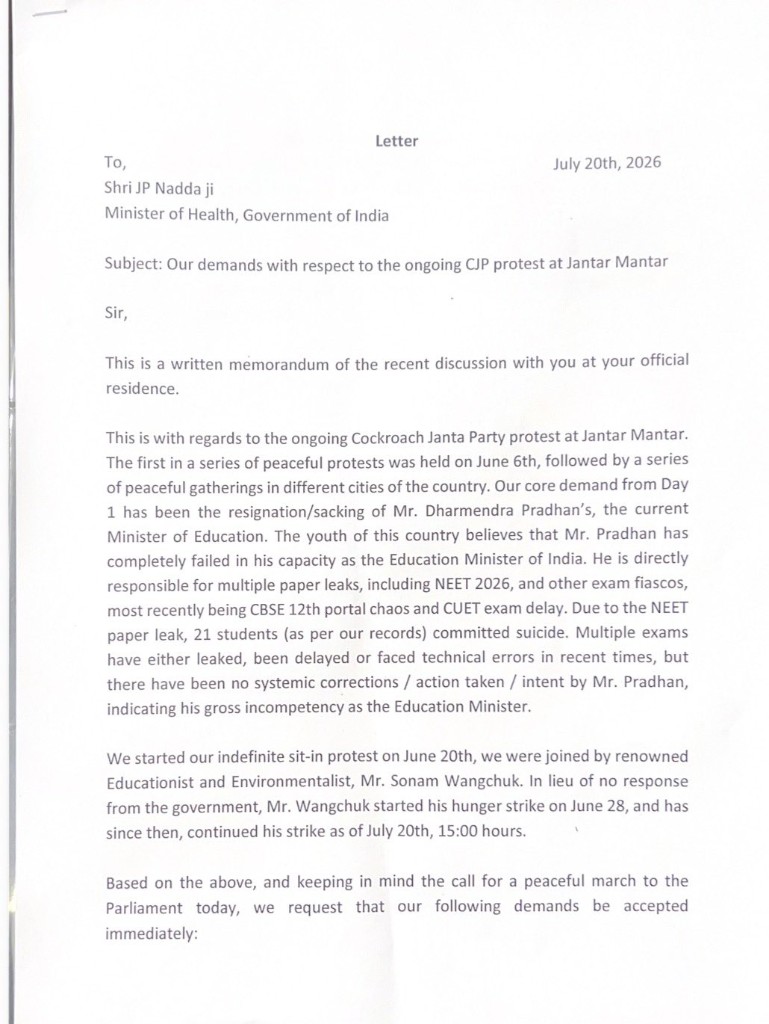
CJP · Saurav Das & Ashutosh Ranka → JP Nadda
Phase 09
Formal memorandum to Union Health Minister J. P. Nadda
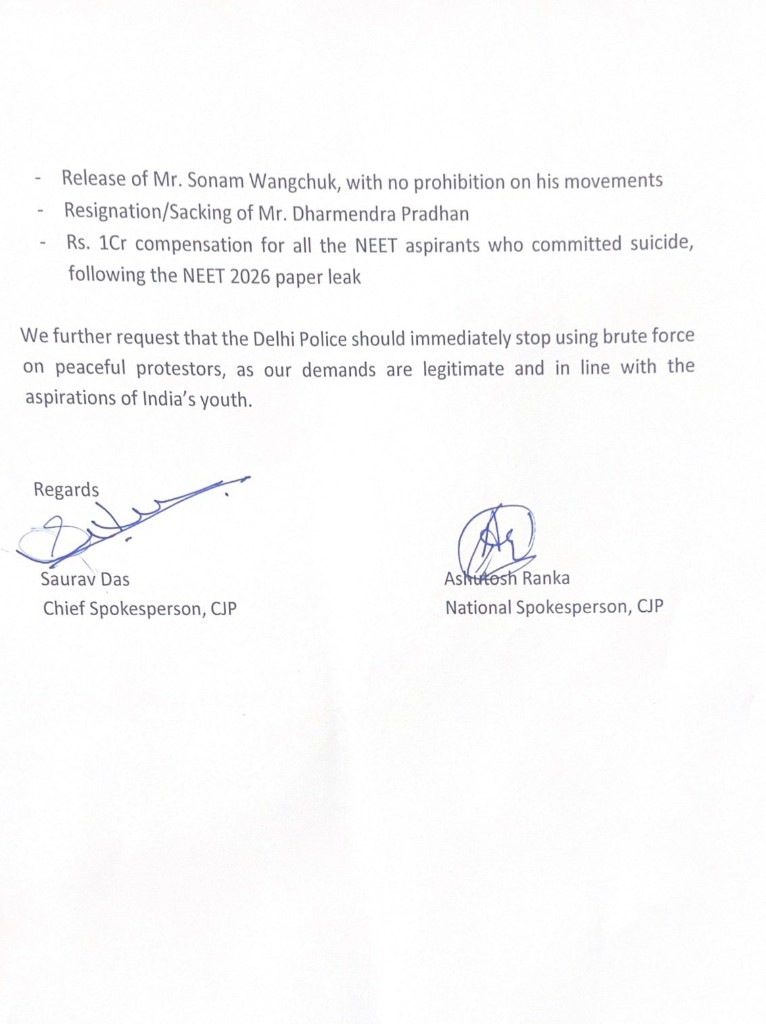
Written letter dated 20 July 2026, addressed to Shri JP Nadda, Minister of Health, Government of India. Subject: “Our demands with respect to the ongoing CJP protest at Jantar Mantar.” Signed by Saurav Das (Chief Spokesperson, CJP) and Ashutosh Ranka (National Spokesperson, CJP).
What changed: CJP’s street agenda was reduced to a formal three-point memo plus a further request to stop police force — including the new ask for Wangchuk’s unrestricted release after hospitalisation.
- 01
Release of Mr. Sonam Wangchuk, with no prohibition on his movements
CJP asked that Sonam Wangchuk be released and allowed to move freely, after he was taken from the protest site during his hunger strike.
- 02
Resignation / sacking of Mr. Dharmendra Pradhan
The letter holds the Education Minister responsible for paper leaks including NEET 2026, CBSE 12th portal chaos, CUET delays, and the deaths of students — and demands his immediate resignation or sacking.
- 03
₹1 crore compensation for NEET aspirants who died by suicide after the 2026 paper leak
CJP demanded Rs. 1Cr compensation for every NEET aspirant who committed suicide following the NEET 2026 paper leak.
- 04
Stop brute force on peaceful protestors
CJP further requested that Delhi Police immediately stop using brute force on peaceful protestors, stating the demands are legitimate and in line with the aspirations of India’s youth.
Source document
Official demands letter
Sources
On the timeline
Proof on posts archive
- 01
Sonam Wangchuk (from hospital)
Phase 10
After police action: continue fast until youth can meet MPs
Following reports of force during Sansad Chalo, Wangchuk issued another handwritten note. Major outlets (Economic Times, TOI, BBC) report he continued the fast; some later reports claimed he ended it after the Nadda meeting. This page follows the handwritten-note and major wire reporting that the fast continued under new meeting conditions.
What changed: Exit condition narrowed again to access: youth leaders meet parliamentarians at Sansad Bhawan, or Wangchuk meets them at hospital.
- 01
Continue fasting until youth leaders are allowed to meet parliamentarians at Sansad Bhawan
- 02
Or until Wangchuk is allowed to meet parliamentarians at the hospital
- 03
Hope that the government will fix accountability of the education minister
Stated as a hope alongside the meeting conditions.
- 04
Appeal to allow students to present grievances before Parliament peacefully
Sources
On the timeline
Proof on posts archive
- 01
CJP / Abhijeet Dipke
Phase 11
Sit-in continues; standing asks unresolved
After Sansad Chalo and the first Nadda meeting, CJP said the sit-in continues. Standing demands remain Pradhan’s resignation and exam-system accountability. Conditional actions around detainees were contested by Delhi Police. Later on 22 July, Wangchuk and CJP each restated exit/negotiation terms (see following phases).
- 01
Protest continues until Dharmendra Pradhan resigns
- 02
Exam-system accountability remains unresolved
- 03
Conditional protest at Delhi Police HQ if detained protesters are not released
CJP raised detention concerns; Delhi Police disputed mass-detention / Dipke-detention claims in public statements.
Sources
On the timeline
Proof on posts archive
- 01
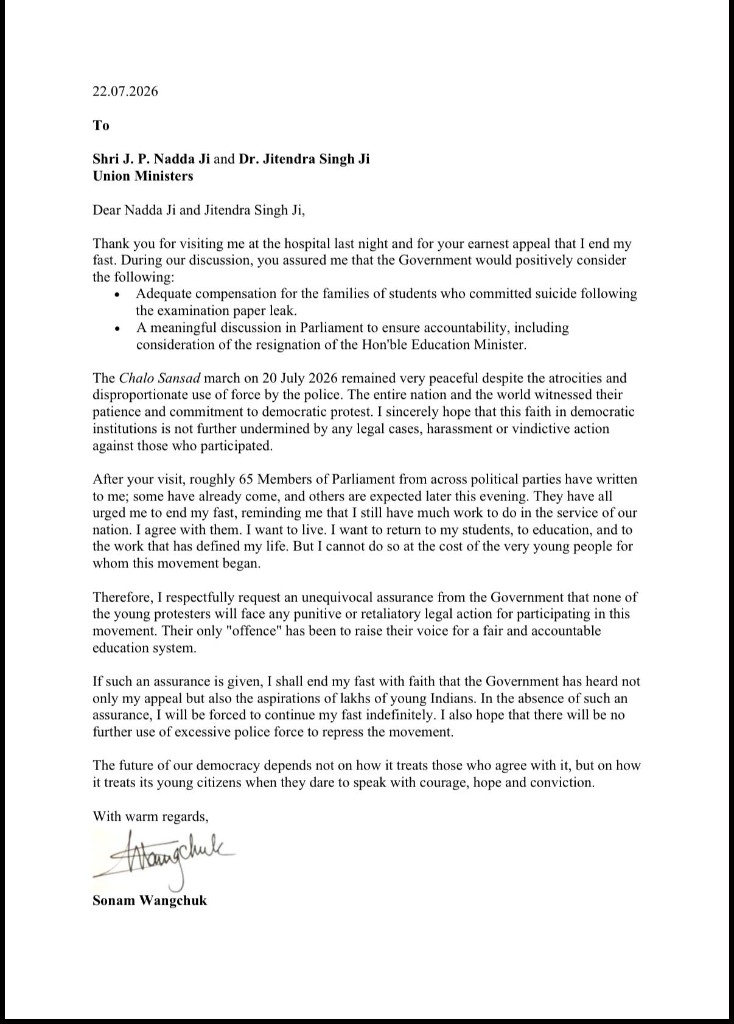
Sonam Wangchuk → J. P. Nadda & Dr. Jitendra Singh
Phase 12
Letter: end fast only with no punitive legal action
Dated 22.07.2026 and addressed to Union Ministers J. P. Nadda and Dr. Jitendra Singh after their Medanta hospital visit the previous night. Wangchuk thanks them for urging him to end the fast, records their stated willingness to positively consider compensation and a Parliament accountability discussion (including considering the Education Minister’s resignation), and sets a hard exit condition for ending the hunger strike.
What changed: Exit condition shifts from meeting-access terms to an unequivocal government assurance that young protesters will not face punitive or retaliatory legal action — distinct from CJP’s parallel public ask that Wangchuk end the fast while the street fight continues.
- 01
Unequivocal assurance that no young protester faces punitive or retaliatory legal action for joining the movement
Stated as the condition on which Wangchuk will end his fast; without it, he says the fast continues indefinitely.
- 02
End the use of excessive police force to repress the movement
- 03
Positive consideration of adequate compensation for families of students who died by suicide after the exam paper leak
Recorded in the letter as an assurance the ministers said the government would positively consider.
- 04
Meaningful Parliament discussion on accountability, including considering the Education Minister’s resignation
Recorded as a ministers’ assurance from the hospital meeting, not a new unilateral government commitment published separately.
- 05
No further harassment or vindictive action against Chalo Sansad participants
Wangchuk describes the 20 July march as peaceful despite alleged police force and hopes protesters will not face further harassment.
Sources
On the timeline
Proof on posts archive
- 01
CJP (@Cockroachisback)
Phase 13
IMPORTANT evening restatement: four demands
CJP posts that protests will continue until the government accepts its demands. Official list — Dharmendra Pradhan’s resignation; ₹1 crore compensation for families of children who died by suicide; no prosecution of peaceful protesters; all police officials involved in committing atrocities must be prosecuted.
What changed: Public four-point restatement after Sansad Chalo adds accountability for alleged police atrocities alongside resignation, compensation, and non-prosecution of peaceful protesters. Parallel to — not identical with — Wangchuk’s lettered exit condition the same day. The 20 July Nadda memo’s Wangchuk-release ask is not repeated in this evening list.
- 01
Dharmendra Pradhan’s resignation
- 02
₹1 crore compensation for families of children who died by suicide
- 03
No prosecution of peaceful protesters
Listed in CJP’s ~6:15 PM IMPORTANT restatement.
- 04
All police officials involved in committing atrocities must be prosecuted
Fourth demand in CJP’s ~6:15 PM post — distinct from Wangchuk’s no-punitive-legal-action exit condition.
Sources
On the timeline
Proof on posts archive
- 01
Wangchuk + Union ministers / CJP
Phase 14
Wangchuk ends fast on assurances; CJP keeps Pradhan resignation demand
After late-night negotiations at Medanta, Wangchuk ends his 26-day hunger strike following government written assurances on non-violent protesters and related asks. CJP welcomes his recovery but states the Jantar Mantar sit-in continues until Dharmendra Pradhan resigns.
What changed: Wangchuk’s personal fast exit conditions are treated as addressed via written assurances (no punitive cases against peaceful protesters; compensation under consideration; reform/debate track). CJP’s remaining non-negotiable public demand centres on Pradhan’s resignation; the four-demand evening list from 22 July is not withdrawn.
- 01
No punitive cases against non-violent / peaceful protesters
Reported written assurance accompanying Wangchuk ending his fast.
- 02
Compensation for suicide-victim families under consideration
Reported as part of the government assurance package.
- 03
Parliamentary / exam-reform track on paper leaks
Parallel to Modi’s fast-track courts messaging and Cabinet bill discussion.
- 04
Resignation of Dharmendra Pradhan (CJP — ongoing)
Dipke/CJP: protest continues at Jantar Mantar until Pradhan resigns.
Sources
Proof on posts archive
- 01
CJP (Das / Ranka) ↔ Union ministers Nadda & Jitendra Singh
Phase 15
Three non-negotiable negotiation asks; in-principle on two
At Constitution Club / Vithalbhai Patel House talks lasting ~two hours, CJP places three written non-negotiable demands and a five-point exam-reform charter. CJP says the Centre responded in principle on compensation and FIR withdrawal, sought time until 25 July afternoon on Pradhan’s resignation, and scheduled a follow-up meeting (~3:30 pm Saturday).
What changed: This negotiation package is distinct from CJP’s 22 July evening four-demand IMPORTANT restatement (which remains the homepage standing list). The 24 July talks centre resignation + ₹1 crore compensation + FIR withdrawal as the three primary asks; broader reform is deferred until those are addressed. CJP issues a 1–2 day ultimatum for a larger nationwide call if Pradhan is not removed.
- 01
Resignation or dismissal of Dharmendra Pradhan
Stated non-negotiable. Govt seeks time until Saturday 25 July afternoon; some outlets cite sources ruling resignation out — contested, attributed.
- 02
₹1 crore compensation for NEET suicide-victim families
CJP says Centre expressed in-principle approval during the 24 July meeting.
- 03
Withdraw FIRs / cases against protesters; no fresh punitive cases
CJP says Centre expressed in-principle approval, plus assurance against continuing indiscriminate detentions if occurring.
- 04
Five-point exam-reform charter (secondary track)
Presented to ministers; CJP says deeper deliberation waits until the three primary demands — starting with Pradhan’s exit — are met.
Sources
On the timeline
Proof on posts archive
- 01
Dharmendra Pradhan / CJP (Dipke)
Phase 16
Pradhan resigns; CJP marks demand met, sit-in continues
Union Education Minister Dharmendra Pradhan tenders his resignation to PM Modi amid the NEET leak protests. CJP and protesters at Jantar Mantar celebrate and mark the resignation demand achieved. Dipke / CJP say the agitation continues until remaining demands — ₹1 crore compensation for suicide-victim families and no action against student protesters — are met.
What changed: The long-standing public red line of Pradhan’s resignation is treated as met. Outstanding asks shift to compensation and no punitive action against protesters (plus broader police-accountability framing in some quotes). Do not read this phase as the protest ending.
- 01
Resignation of Dharmendra Pradhan — Met
Pradhan resigns as Union Education Minister (25 July afternoon). CJP checklist marks this demand done.
- 02
₹1 crore compensation for NEET suicide-victim families — Pending
CJP posts this as PENDING after the resignation and says the sit-in continues until it is met.
- 03
No action against student protesters — Pending
CJP posts “no action against any of the student protesters” as PENDING; overlaps with the earlier no-prosecution / FIR-withdrawal track.
- 04
Delhi Police / lathi-charge accountability (reported ask)
Some post-resignation coverage quotes Dipke citing resignation of Delhi Police personnel involved in the lathi charge; attribute as reported, not a separate formal letter on this site.
Sources
- Dharmendra Pradhan (X) — resignation letter
- Posts archive embed
- The Hindu
- Economic Times
- Indian Economic Observer / ANI
Proof on posts archive
- 01
CJP (Das / Ranka) ↔ Union ministers Nadda & Jitendra Singh
Phase 17
Joint press; CJP withdraws sit-in after Centre assurances
After afternoon celebrations at Jantar Mantar, CJP and the Centre hold a joint press conference. CJP formally withdraws the agitation in good faith, saying the Centre accepted key remaining asks on agreed timelines. Crowds disperse; Metro gates reopen. Compensation and FIR-withdrawal delivery remain tracked as pending.
What changed: The street sit-in ends. Standing asks shift from “agitation continues” to “assurances accepted; delivery pending.” Pradhan’s resignation stays met. ₹1 crore compensation and no-prosecution / FIR withdrawal stay pending pending implementation. Police-atrocity prosecution is not clearly closed in the joint-press package.
- 01
Resignation of Dharmendra Pradhan — Met
Already achieved afternoon of 25 July; celebrated at Jantar Mantar before the evening withdrawal.
- 02
₹1 crore compensation — Assured; delivery pending
CJP sought ₹1 crore for NEET suicide-victim families. Nadda says compensation per rules / maximum possible; Ranka cites honorary compensation under applicable rules. CJP withdrew contingent on timelines.
- 03
Withdraw FIRs / no action against protesters — Assured; delivery pending
Das / Ranka say the Centre agreed to withdraw FIRs and share copies; a written guarantee on cases is discussed for the coming days.
- 04
Five-point exam-reform charter — Under consideration
Nadda says the government will consider the charter deeply; Ranka cites a follow-up discussion in about four weeks.
Sources
- 01
President / Union Cabinet · aftermath
Phase 18
President accepts resignation; Joshi gets Education charge; site cleared
On the evening of 25 July, the President accepts Dharmendra Pradhan’s resignation and assigns Cabinet Minister Pralhad Joshi additional charge of the Education Ministry. By the morning of 26 July, press reports the Jantar Mantar stage and tents cleared, NDMC cleaning, Metro fully open, and internet in Connaught Place restored. Remaining CJP asks (compensation, FIR withdrawal) stay pending delivery.
What changed: Formal closure of the Education Minister post under Pradhan, with Joshi holding additional charge. Physical sit-in infrastructure is gone. Demand statuses do not flip: resignation remains met; compensation / FIR / police-accountability asks remain pending.
- 01
Resignation of Dharmendra Pradhan — Formally accepted
President Droupadi Murmu accepts Pradhan’s resignation from the Union Council of Ministers with immediate effect (Article 75(2)), on the advice of the Prime Minister.
- 02
Pralhad Joshi — Additional charge of Education
Cabinet Minister Pralhad Joshi is given additional charge of the Education Ministry alongside his existing portfolios. This is a government allocation, not a new CJP demand phase.
- 03
₹1 crore compensation / FIR withdrawal — Still pending delivery
Centre assurances from the 25 July joint press remain tracked as pending; site clearance and Metro/internet normalcy do not equal delivery of money or case withdrawals.
Sources
- 01
CJP (Das / Ranka / Ratna Singh) ↔ Centre / state notifications
Phase 19
FIR assurance follow-through: breach warning, then Bihar/Assam notifications
Two days after the sit-in withdrawal, CJP alleges the Centre is breaching 25 July assurances on FIR withdrawal and no police action, warning it may restart protests if a written guarantee is not shared by Tuesday. Overnight, CJP says government representatives shared Bihar and Assam notifications on FIR withdrawal, release of detainees, and no future action — with more NDA-state / Union guarantees promised. Compensation remains pending.
What changed: No-prosecution / FIR track moves from “assured at joint press” to “partial state notifications reported; nationwide written guarantee still pending.” Resignation stays met. ₹1 crore compensation stays pending. Do not mark FIR ask met on Bihar/Assam drafts alone.
- 01
Withdraw FIRs / no action — Assured; partial progress; delivery pending
CJP alleges continuing arrests/cases after 25 July. After its Tuesday-deadline warning, it cites Bihar and Assam notifications guaranteeing withdrawals and releases; Union / other NDA-state guarantees still promised, not fully delivered nationwide.
- 02
₹1 crore compensation — Still pending delivery
No public confirmation of payout delivery in this phase; remains pending under the 25 July Centre assurances.
- 03
Legal support network (reported)
Kapil Sibal announces ₹1 crore toward legal aid and a nationwide pro-bono lawyer network; CJP mentions legal-help and Sakshi evidence portals — support infrastructure, not a government demand status flip.
Sources
- 01
Supreme Court ↔ Centre / states ↔ CJP
Phase 20
SC clarifies states may close/withdraw protest FIRs; venue PIL notice
The Supreme Court clarifies that its 28 July interim order does not stop Delhi or other states from closing or withdrawing CJP-protest FIRs in accordance with law, and that “criminal antecedents” means grave and heinous offences. The Centre says it is engaging CJP on the legal mechanism. The same period, SC issues notice on a PIL seeking an alternative to Jantar Mantar as a designated protest site. Compensation remains pending; nationwide FIR closure stays process-dependent.
What changed: No-prosecution / FIR track gains a clearer judicial path for state closure/withdrawal, plus narrowed carve-out language — still not a completed nationwide amnesty delivery. Venue/public-space litigation opens a separate track affecting Jantar Mantar. Resignation stays met; ₹1 crore compensation stays pending.
- 01
Withdraw FIRs / no action — Judicial path clarified; delivery pending
States/Delhi may close or withdraw cases under law; student protection carve-out limited to those without grave/heinous antecedents. Bihar/Assam notifications and Centre–CJP engagement continue as political/process layers — do not mark the FIR ask fully met.
- 02
₹1 crore compensation — Still pending delivery
No public confirmation of payout delivery in this phase; remains pending under the 25 July Centre assurances.
- 03
Jantar Mantar as protest site — Contested venue track
SC notice on PIL for an alternative designated site; later Delhi HC observations (7 August) question protests at JM. Distinct from CJP’s written education demands, but central to the movement’s public space.
Sources
- 01
CJP National Working Committee / Dipke
Phase 21
Pressure-group expansion: NWC, I-Day petition, Jharkhand solidarity
After a Sambhajinagar strategy meet, CJP announces it will remain a nationwide pressure group (not a party), forms a National Working Committee (Dipke national convener; Das and Ranka co-conveners), launches a petition asking the PM to address youth on education, jobs and cost of living on 15 August, reacts to Delhi HC remarks on Jantar Mantar, and joins Jharkhand recruitment-exam protesters in Ranchi. Dipke frames next focus on PSC exams and gig workers. Standing July demands (compensation; full FIR closure) stay pending; Delhi sit-in not reported restarted.
What changed: Movement framing expands from NEET/Delhi sit-in delivery to organisation-building and multi-issue youth agenda. Does not flip met/pending status on Pradhan resignation (met), compensation (pending), or nationwide FIR closure (pending).
- 01
Organisation — National Working Committee announced
Dipke national convener; Das and Ranka co-conveners; planned state/Lok Sabha/city units and membership drive. Wangchuk described as continuing mentor (attributed).
- 02
New public asks — I-Day youth address; PSC / gig agenda
Petition for Modi’s 15 August speech on education, unemployment and cost of living; Dipke interview sets PSC exam irregularities and gig/unorganised workers as next focus — additional campaign asks, not replacements for pending July deliveries.
- 03
State solidarity — Jharkhand recruitment protests
CJP delegation at Ranchi (8 August); Dipke absent citing health. Separate from Delhi sit-in restart.
Sources
- 01
Found an error or a missing dated beat with a credible source? Send a correction.
FAQ
FAQ on CJP protest demands
Quick answers about how the Delhi Jantar Mantar / Cockroach Janta Party demand charter evolved. Pair this with the full protest timeline.
How did CJP protest demands change over time?
Demands evolved from Dipke’s May 2026 five-point political manifesto, to a June education focus on Dharmendra Pradhan’s resignation and a five-point exam manifesto, then a ₹1 crore compensation ask for NEET suicide-victim families, Wangchuk’s hunger-strike terms (later revised around 19–20 July), CJP’s formal 20 July letter to J. P. Nadda, Wangchuk’s 22 July letter requiring a no-punitive-legal-action assurance to end his fast, CJP’s ~6:15 PM four-demand restatement, Wangchuk ending his fast on 23–24 July, CJP’s 24 July three non-negotiable negotiation asks (Pradhan resign, ₹1 crore compensation, withdraw FIRs), and — on 25–26 July — Pradhan’s resignation (met), President acceptance with Pralhad Joshi’s Education charge, CJP withdrawing the sit-in after Centre assurances, and site clearance, with compensation and no-action asks still pending delivery.
What was in CJP’s exam manifesto?
On 11 June 2026 in Pune, CJP released a five-point exam manifesto reported as including ₹10,000 compensation for leak/delay-hit students, backup exams within 72 hours, physical answer-sheet evaluation, age-limit protection after delays, and independent tender/technology audits. Some reports also listed results within one month.
How did Sonam Wangchuk’s demands change?
Wangchuk’s hunger strike initially centred on Pradhan’s resignation. On 19 July his wife conveyed new exit terms; on 20–22 July his conditions shifted again, culminating in a 22 July letter requiring a no-punitive-legal-action assurance. He ended the 26-day fast on 23–24 July after government written assurances. Pradhan resigned on 25 July; that evening CJP formally withdrew the Jantar Mantar sit-in after Centre assurances, with remaining asks pending delivery.
What did CJP demand in the letter to J. P. Nadda?
The 20 July 2026 memorandum asked for Sonam Wangchuk’s release without movement restrictions, resignation/sacking of Dharmendra Pradhan, ₹1 crore compensation for each NEET aspirant who died by suicide after the 2026 paper leak, and that Delhi Police stop using brute force on peaceful protesters. Later public restatements (22 July) shifted emphasis; see the chronology phases below.
What did Wangchuk’s 22 July letter demand?
Addressed to J. P. Nadda and Dr. Jitendra Singh after their Medanta visit, Wangchuk said he would end his fast only with an unequivocal government assurance that no young protester faces punitive or retaliatory legal action. He also called for an end to excessive police force and recorded the ministers’ stated willingness to positively consider compensation and a Parliament accountability discussion, including considering the Education Minister’s resignation.
What were CJP’s four demands on 22 July evening?
Around 6:15 PM CJP posted an IMPORTANT restatement: Dharmendra Pradhan’s resignation; ₹1 crore compensation for families of children who died by suicide; no prosecution of peaceful protesters; and all police officials involved in committing atrocities must be prosecuted.
Did Wangchuk end his hunger strike?
Yes. On 23–24 July 2026 he ended his 26-day fast at Medanta after government written assurances reported around non-violent protesters and related asks. CJP said it was relieved but that the Jantar Mantar sit-in continues until Pradhan resigns. After Pradhan resigned on 25 July, CJP marked resignation met and that evening formally withdrew the sit-in after Centre assurances; remaining asks stay pending delivery.
What were CJP’s three non-negotiable asks on 24 July?
In Centre–CJP talks with Nadda and Jitendra Singh, CJP placed three written non-negotiable demands: resignation or dismissal of Dharmendra Pradhan; ₹1 crore compensation for families of NEET aspirants who died by suicide; and withdrawal of FIRs / cases against protesters with no fresh punitive cases. CJP said the government expressed in-principle approval on compensation and FIR withdrawal and sought time until 25 July afternoon on resignation. The next day Pradhan resigned; that evening CJP withdrew the sit-in after a joint press, with compensation and no-action asks still pending delivery.
Did Dharmendra Pradhan’s resignation end the CJP demands list?
No. CJP marked Pradhan’s resignation as achieved on 25 July and withdrew the street sit-in after Centre assurances — but remaining asks stay PENDING. By 27–28 July CJP cited Bihar and Assam notifications as partial FIR progress; the Supreme Court then set a 28 July–3 August path for state closure/withdrawal of protest FIRs. ₹1 crore compensation and nationwide FIR closure are still not treated as fully delivered. August organisation asks (I-Day petition, PSC/gig agenda) are additional campaign framing, not a flip of those pending deliveries.
Is this demands page affiliated with CJP?
No. It is independent documentation compiled from public reporting and primary documents. It is not affiliated with CJP, any political party, or any government.
Read more
How can I correct an error or add a missing demand phase?
If you find an error or a missing dated beat with a credible public source, send a correction via the homepage contact form and choose “Report a correction.” Include the date, claim, and a link to a reliable source so the chronology can be verified and updated. Cross-check dates on the full protest timeline.